

Audiologist or Hearing Aid Specialist: Which One Should You See?

An audiologist holds a doctoral degree (Au.D.) and is licensed to diagnose, treat, and manage hearing and balance disorders. A hearing aid specialist is licensed to test hearing, assist in the selection of hearing aids, and prescriptively fit them to an individual’s specific hearing loss. Audiologists tend to be broader in their scope of practice, whereas hearing aid specialists are experts specifically in the hearing aid field. Which one you should see depends on your symptoms. If you’re experiencing dizziness or balance issues, chronic ear infections, or ear pain, an audiologist is recommended. If you’re having problems understanding conversations, others are complaining the TV is too loud, or people seem to be mumbling, a hearing aid specialist might be your best bet.
For most people with gradual, age-related hearing loss and no other symptoms, either provider can help. For anything sudden, one-sided, painful, or accompanied by dizziness, you want an audiologist or a physician, and you want them quickly.
Audiologist vs Hearing Aid Specialist: Side-by-Side Comparison
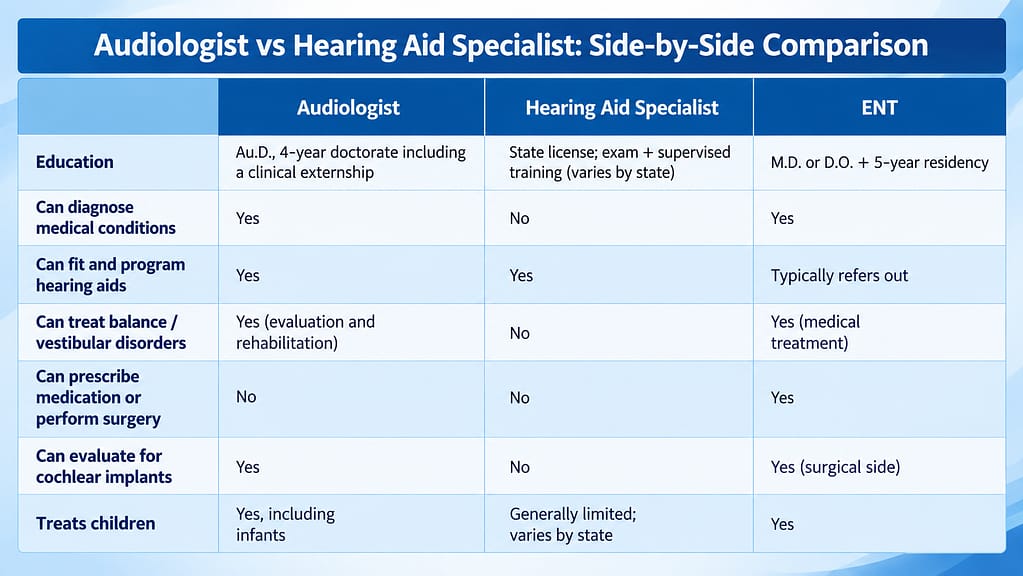
| Audiologist | Hearing Aid Specialist | ENT | |
| Education | Au.D., 4-year doctorate including a clinical externship | State license; exam + supervised training (varies by state) | M.D. or D.O. + 5-year residency |
| Can diagnose medical conditions | Yes | No | Yes |
| Can fit and program hearing aids | Yes | Yes | Typically refers out |
| Can treat balance / vestibular disorders | Yes (evaluation and rehabilitation) | No | Yes (medical treatment) |
| Can prescribe medication or perform surgery | No | No | Yes |
| Can evaluate for cochlear implants | Yes | No | Yes (surgical side) |
| Treats children | Yes, including infants | Generally limited; varies by state | Yes |
What Each Provider Can Do for You
What an Audiologist Does
- Comprehensive hearing evaluation: testing through headphones and through the bone behind the ear (which shows whether the problem is in the inner ear or the middle ear), word-recognition testing, and eardrum pressure testing
- Diagnosing the type of hearing loss (conductive, sensorineural, or mixed) and identifying where it originates
- Tinnitus evaluation and management
- Balance and vestibular testing for dizziness and unsteadiness
- Hearing aid selection, fitting, and real-ear verification, measuring the sound actually delivered inside your ear canal to confirm it matches your prescription
- Cochlear implant candidacy evaluation and programming
- Cerumen (earwax) management
- Custom hearing protection and musicians’ earplugs
- Pediatric testing, including newborn and infant assessment
What a Hearing Aid Specialist Does
- Comprehensive hearing evaluation: testing through headphones and through the bone behind the ear (which shows whether the problem is in the inner ear or the middle ear), word-recognition testing, plus eardrum pressure testing when the ear exam points to a middle ear issue
- Helping you select an appropriate hearing aid style and technology level
- Hearing aid selection, fitting, and real-ear verification, measuring the sound actually delivered inside your ear canal to confirm it matches your prescription
- Taking ear impressions for custom devices and earmolds
- Tinnitus evaluation and management
- Fitting and programming devices to your audiogram
- Follow-up adjustments as your brain acclimates to amplification
- Hearing aid cleaning, maintenance, minor repairs, and troubleshooting
- Ongoing device support over the life of the hearing aids
- Cerumen (earwax) management
- Custom hearing protection and musicians’ earplugs
The hearing aid specialist’s focus is more specific, but the work is genuinely skilled. A well-fitted mid-range hearing aid outperforms a poorly fitted premium one, every time. Fitting quality is not a lesser concern than diagnosis; it is simply a different one.
When to See an Audiologist
Some symptoms warrant a diagnostic evaluation before anyone discusses hearing aids. See an audiologist or a physician if you have:
- Sudden hearing loss. This is a medical emergency. Be seen right away. Clinical guidelines from the American Academy of Otolaryngology-Head and Neck Surgery call for hearing testing within 14 days of onset and steroid treatment within 2 weeks; outcomes are generally better the sooner treatment begins. If several days have already passed, still go: treatment options remain available for weeks after onset. Do not wait to see whether it clears up on its own.
- Hearing loss in one ear only. Asymmetric loss can point to causes that need medical evaluation rather than amplification.
- Dizziness, vertigo, or balance problems alongside hearing changes. The balance and hearing systems share the inner ear, and symptoms in either system require diagnostic testing.
- New or worsening tinnitus, particularly if it is in one ear, pulses in time with your heartbeat, or arrived suddenly.
- Ear pain, drainage, or pressure, which suggests a medical condition rather than age-related loss.
- A child with suspected hearing problems. Pediatric testing requires specific training and equipment, and early identification meaningfully affects speech and language development.
- A desire for a full diagnostic workup before you make any treatment decision, which is a perfectly good reason on its own.
When a Hearing Aid Specialist May Be Enough
For a large share of adults, the situation is straightforward and a specialist can handle it well:
- Gradual, age-related hearing loss in both ears with no other symptoms
- You already know you need hearing aids and want help choosing, fitting, and adjusting them.
- Follow-up adjustments, reprogramming, or repairs on devices you already own
- Replacing hearing aids that are several years old with a comparable current model
One important practical note: you rarely have to make this call entirely on your own. A good hearing care provider will take your history, test your hearing, and be honest about what the results mean. If something in your evaluation points to a medical cause, they will refer you to an audiologist or ENT rather than simply sell you a device.
That referral behavior is the real test of a hearing care provider, and it is a reasonable thing to ask about before you book. It is exactly how Clear-Tone operates: as hearing instrument specialists, we fit and care for hearing aids, and we refer out when your situation calls for medical or diagnostic care we do not provide.
What to Expect at Your First Appointment (Either Provider)
The structure of a first visit looks broadly similar regardless of which provider you see:
- Case history. Questions about when you noticed the change, whether it affects one ear or both, noise exposure, medications, family history, tinnitus, and dizziness.
- Visual ear examination. An otoscope check of the ear canal and eardrum, partly to rule out something as simple and fixable as impacted earwax.
- Hearing testing. In a sound booth, wearing headphones, responding to tones at different pitches and volumes, plus speech testing to measure how well you understand words rather than detect sound.
- Reviewing results. Your audiogram is plotted and explained: what you can hear, what you cannot, and what that means for real-world conversation.
- Next steps. These may be hearing aids, a medical referral, a recommendation to monitor and retest, or earwax removal.
A comprehensive diagnostic evaluation goes further than a screening: it identifies the type and degree of loss rather than simply flagging that loss exists. Our comprehensive hearing test and evaluation page walks through what is included.
Hearing Care in Tulsa: How Clear-Tone Handles It
Clear-Tone Hearing Aids is a Tulsa hearing care practice staffed by experienced hearing care professionals and licensed hearing instrument specialists. Our focus is the part most people are actually looking for: a straightforward hearing evaluation, an honest recommendation, and hearing aids fitted and fine-tuned to how you hear.
Patients receive a hearing evaluation that measures the degree of your hearing loss and what it means for you day-to-day. If anything in your results points toward a medical cause, we will tell you and refer you to an audiologist or ENT rather than routing you straight to a device.
If hearing aids are the right answer, the fitting matters as much as the selection: careful programming to your hearing profile, and follow-up adjustments over the weeks that follow as your brain re-learns sounds it has been missing. Fitting and caring for hearing aids is what we do every day, and it is where a specialist earns their keep.
You can see the full range of our hearing services on our hearing services page. If tinnitus is your primary concern, our tinnitus management page covers evaluation and management options.
To schedule a free hearing test and evaluation in Tulsa, call Clear-Tone Hearing Aids at (918) 493-4000.
Frequently Asked Questions
What is the difference between an audiologist and a hearing aid specialist?
An audiologist holds a doctoral degree (Au.D.) and is licensed to diagnose and treat hearing and balance disorders, including tinnitus and vestibular conditions. A hearing aid specialist holds a state license to test hearing and fit hearing aids. Both can fit and program hearing aids.
Is seeing an audiologist worth it?
For most people, yes, particularly for a first evaluation. An audiologist can identify the type and cause of your hearing loss, not just its degree, and can catch conditions that need medical treatment rather than amplification. If your hearing loss is straightforward and you mainly need device support, a licensed hearing aid specialist can serve you well.
Can a hearing aid specialist diagnose hearing loss?
A hearing aid specialist can test your hearing and identify that hearing loss is present and how severe it is. If testing suggests a medical condition, they will refer you to an audiologist or ENT.
Is a doctor’s referral required before scheduling an appointment with an audiologist?
Usually not. Most audiologists accept patients directly. Some insurance plans require a referral from your primary care physician for coverage, so it is worth calling your insurer before booking.
Can an audiologist detect inner ear problems?
Yes. Audiologists use diagnostic testing to distinguish inner-ear (sensorineural) problems from middle- and outer-ear (conductive) problems, and can perform vestibular testing to evaluate inner-ear balance function. Treating a diagnosed inner ear condition, medically or surgically, is left to a physician.
Should I see an audiologist or an ENT for ringing in my ears?
Start with a hearing evaluation and tinnitus assessment, which a hearing care provider or audiologist can do. See an ENT promptly if the tinnitus is in one ear only, pulses in rhythm with your heartbeat, began suddenly, or comes with hearing loss, dizziness, or ear pain.
How much does an audiologist visit cost without insurance?
Costs vary by clinic and by what the visit includes. A hearing screening is typically inexpensive or complimentary, while a comprehensive diagnostic evaluation costs more because it involves substantially more testing. Ask what the appointment includes when you book. Clear-Tone offers a free hearing test and evaluation for Tulsa-area patients. For a broader look at factors that affect hearing care costs, see our guide to hearing aid costs in Tulsa.
Does Clear-Tone have an audiologist on staff?
Clear-Tone’s team is made up of hearing care professionals and licensed hearing instrument specialists who focus on hearing evaluation, hearing aid selection, fitting, and ongoing care. If your situation points to a medical or diagnostic need, we refer you to an audiologist or ENT. Call (918) 493-4000 to schedule an evaluation.