

What Affects the Cost of Hearing Aids in Tulsa? A 2026 Guide

What you pay for hearing aids in Tulsa comes down to four things: whether you buy over-the-counter or prescription devices, the technology level inside them, the style you choose, and how much professional care is bundled into the price. That last factor is the one most people overlook, and it is why two clinics can quote very different numbers for what looks like the same thing.
The Four Categories of Hearing Aids
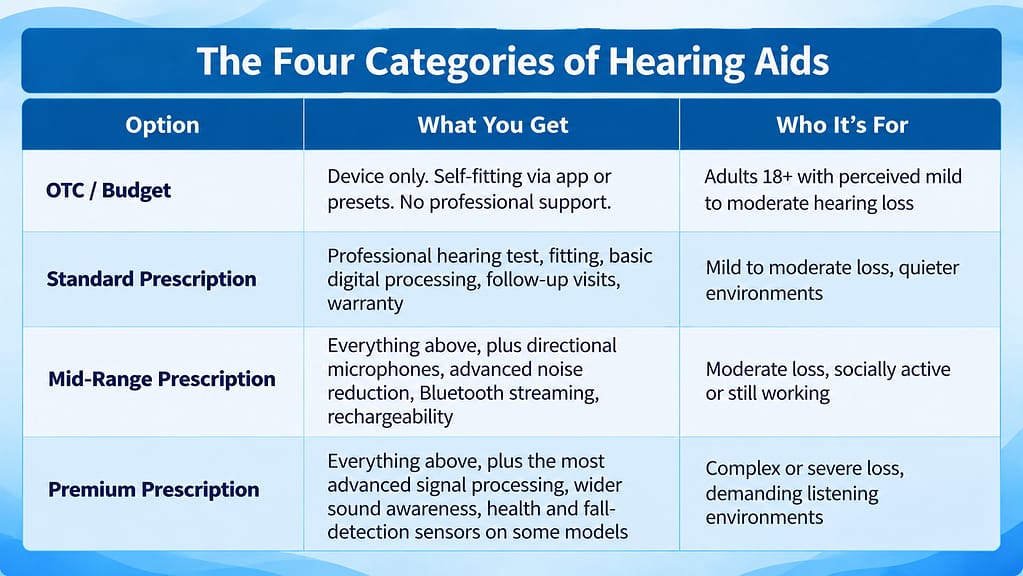
| Category | What’s Typically Included | Best For |
| OTC / Budget | Device only. Self-fitting via app or presets. No professional support. | For those with mild hearing loss who rarely / never participate in a group setting with more than one speaker |
| Standard Prescription | Professional hearing test, fitting, basic digital processing, follow-up visits, warranty | For those with mild to severe hearing loss who primarily struggle in one-on-one conversations or small groups (1-3 people) in a quiet environment |
| Mid-Range Prescription | Everything above, plus directional microphones, advanced noise reduction, Bluetooth streaming, rechargeability | For those with mild to severe hearing loss who regularly engage in one-on-one conversations or in small to medium size groups (1-5 people) in quiet or moderately noisy environments (e.g. church / social gatherings, restaurants etc.) |
| Premium Prescription | Everything above, plus the most advanced signal processing, wider sound awareness, health and fall-detection sensors on some models | For those with mild to severe hearing loss who frequently engage in one-on-one conversations or in small to large size groups (1-10+ people) in quiet or noisy environments (e.g. church / social gatherings, busy restaurants, large crowds etc.) |
Since the FDA’s over-the-counter rule took effect in October 2022, adults 18 and older with perceived mild-to-moderate hearing loss have been able to buy certain hearing aids without a prescription, exam, or fitting. For the right person, that is reasonable, but you are fitting it yourself without an audiogram to back it up, and people routinely underestimate their own hearing loss. Devices for more severe loss, and any device for someone under 18, remain prescription-only.
Among prescription tiers, mid-range is the most common choice. Premium platforms (Starkey’s Omega AI line among them) add machine-learning-driven processing and, on some models, health sensors. Premium is not automatically better for you; it is better in hard listening situations, and someone with a quiet routine may hear no meaningful difference.
What’s Actually Included in the Price?
This is the part most cost comparisons skip, and where people get surprised.
Bundled pricing means the quoted price covers the devices and the services around them: evaluation, fitting, real-ear verification, follow-up adjustments, routine cleanings, and the warranty. Most established Tulsa-area clinics price this way. Unbundled pricing separates them: you pay less for the devices, then pay per visit.
Neither is inherently better; unbundled can save money for someone who needs little follow-up. But comparing sticker prices without knowing what each includes tells you almost nothing, since a lower unbundled quote and a higher bundled one can end up in the same place over three years.
The follow-up matters more than people expect. Adjusting to hearing aids is not like putting on glasses: your brain has been compensating for missing sound for years, and re-learning takes weeks across several appointments. Those visits are what turn a well-chosen device into one you actually wear.
Questions worth asking any provider before you buy:
- How many follow-up visits are included, and for how long?
- Are cleanings and wax guard replacements included?
- What is the trial period, and is anything owed if I return the devices?
- What does the warranty cover, and does it include loss and damage?
At Clear-Tone, where hearing care professionals are on staff, the process starts with a free hearing test and evaluation, and fittings begin with a risk-free trial with no obligation to purchase. Ask us to put the trial terms in writing and include them with the device quote.
How Style Affects Cost
Style affects what you pay, though the level of technology affects it more, so consider the two together.
- Behind-the-Ear (BTE): electronics are placed behind the ear, with tubing connecting to a custom earmold. Powerful and durable, suitable across the widest range of loss. Often the most cost-effective choice at a given tier.
- Receiver-in-Canal (RIC): the most popular style in 2026. The receiver sits in the canal on a thin wire, making the piece behind the ear smaller and practically invisible.
- In-the-Ear (ITE): custom-molded to fill the outer ear bowl. Room for larger batteries and more features, and easier to handle if dexterity is a concern.
- Completely-in-Canal (CIC) and Invisible-in-Canal (IIC): the most discreet options. Miniaturization carries a premium and limits battery life and features. Best for mild to moderate loss.
Our hearing aid styles page compares these in more detail and lets you browse the hearing aids we currently carry.
Does Insurance Cover Hearing Aids in Oklahoma?
Coverage is inconsistent, and the details depend heavily on your specific plan.
Private insurance varies widely. Some employer plans include a hearing aid benefit on a multi-year replacement cycle; many include nothing. Call Member Services to settle it fastest, or let us handle it. At Clear-Tone, our team can check your benefits before your appointment and have them ready for you when you come in for testing.
Original Medicare (Parts A and B) does not cover hearing aids or routine hearing exams. Part B covers diagnostic hearing and balance exams your doctor orders to evaluate a medical condition. Since 2023, you can also see an audiologist directly once every 12 months without an order for certain non-acute diagnostic tests. Balance testing still requires an order, and neither route covers testing for fitting hearing aids.
Medicare Advantage (Part C) is different: the large majority of plans include some hearing benefit in 2026, most commonly a fixed annual allowance, sometimes through a specific provider network. Benefits changed for many plans in 2026, so check your Evidence of Coverage and confirm your clinic is in-network before you buy.
Oklahoma Medicaid (SoonerCare) covers hearing evaluations and hearing aids for members under 21, following a physician recommendation and an audiologist’s evaluation, with prior authorization required. For adults 21 and older, SoonerCare does not cover hearing aids furnished by individually contracted providers, but coverage is permitted in an outpatient hospital setting. Ask whether a hospital-based audiology clinic can provide the service. Confirm the current rules with the Oklahoma Health Care Authority, as policies can change.
For a fuller breakdown, see our guide on whether hearing aids are covered by insurance.
Financing and Payment Options in Tulsa
If insurance covers little or nothing, several paths remain.
- Clinic payment plans. Many Tulsa-area clinics offer in-house plans, some interest-free over a fixed term. Worth asking about directly, since they are rarely advertised.
- CareCredit. A health care credit card accepted at many hearing clinics, including Clear-Tone, with promotional terms of 6, 12, 18, or 24 months. Understand the mechanism: these promotions use deferred interest, not waived interest. Interest accrues from the purchase date and is forgiven only if you pay the balance in full before the promotional period ends; if any remains, the full accrued interest is added.
- HSA and FSA accounts. Hearing aids and batteries are qualified medical expenses so that you can pay with pre-tax dollars, an effective discount equal to your marginal tax rate. FSA funds typically must be spent before the plan year ends, or you may forfeit the remaining balance.
- Oklahoma DRS. Vocational rehabilitation services for eligible residents with disabilities. The key qualifier is that assistance is tied to an employment goal, so hearing aids may be covered when part of an individualized plan for employment. Call the DRS statewide line at 1-800-845-8476 and ask for the Tulsa Services to the Deaf and Hard of Hearing office.
- Sertoma (SHARP). Sertoma clubs refurbish donated hearing aids for people in need. The program is run on a club-by-club basis, so contact a local chapter to ask what is available in Tulsa.
- VA benefits. Veterans enrolled in VA health care may be eligible for hearing aids at no cost, worth checking before any private purchase.
Why the Cheapest Hearing Aid Is Not Always the Least Expensive
Sticker price is one number. Cost of ownership is the one that matters: the devices spread across the years you wear them, batteries or charging, consumables, repairs, professional visits if they are not bundled, and a replacement timeline of roughly three to seven years, a span that proper daily cleaning helps extend.
An OTC pair looks dramatically cheaper at the register. But if it is self-fit to the wrong prescription and ends up in a drawer, the real cost is the purchase price for a few months of partial benefit, plus the hearing you did not get back in the meantime. That argues not against OTC devices, but for matching the purchase to the hearing loss, which means knowing what your hearing loss actually is. At Clear-Tone, the hearing test is free, making it the cheapest step in the process and the one that makes every later decision better informed.
Clear-Tone Hearing Aids serves patients throughout the Tulsa area with hearing evaluations, fittings, and ongoing device care. Call (918) 493-4000 to schedule a free hearing test and receive a written quote that clearly outlines exactly what is included.
If you already own hearing aids and are weighing repair against replacement, our hearing aid repair service can often extend their life.
Frequently Asked Questions
What determines how much hearing aids cost?
Four factors: over-the-counter versus prescription, the device’s technology level, the style, and how much professional care is bundled into the price. The last is the one buyers most often miss, and it is why quotes from different clinics are hard to compare.
What is included when I buy hearing aids?
It depends on whether the clinic bundles or unbundles. Bundled pricing typically covers the evaluation, fitting, verification, follow-up adjustments, cleanings, and warranty. Unbundled pricing covers the devices, with visits billed separately. Always ask for the inclusions in writing.
Are there free or low-cost hearing aids in Oklahoma?
Oklahoma DRS may assist when hearing aids support an employment goal. Sertoma’s recycling program provides refurbished devices through local clubs. Veterans enrolled in VA health care may qualify at no cost. SoonerCare covers members under 21 with prior authorization.
Does Medicare cover hearing aids in 2026?
Original Medicare (Parts A and B) does not cover hearing aids or routine hearing exams. Part B covers diagnostic exams ordered by a physician to evaluate a medical condition and, since 2023, also allows direct access to an audiologist once every 12 months for certain non-acute diagnostic tests. Most Medicare Advantage plans include a hearing benefit, but specifics vary.
Are hearing aids an eligible expense under an HSA or FSA?
Yes. Hearing aids and batteries are qualified medical expenses under IRS rules so you can pay with pre-tax HSA or FSA dollars. FSA funds are usually use-it-or-lose-it within the plan year.
How does CareCredit work for hearing aids?
It is a credit card, not a benefit, so approval and limits depend on your credit. Promotional terms run for 6, 12, 18, or 24 months and use deferred interest, meaning interest is charged retroactively if the balance is not paid in full by the deadline.
How often do hearing aids need to be replaced?
Most last three to seven years. Cleaning and regular maintenance extend that; wax and moisture damage shortens it. Many people replace earlier to gain newer technology such as Bluetooth streaming and rechargeability.
How do I get a price for hearing aids at Clear-Tone?
Call (918) 493-4000 to schedule a free hearing test and evaluation. Pricing depends on the technology level and style that best suit your hearing loss. A quote follows the evaluation, and we will put in writing exactly which services are included.