

OTC Hearing Aids vs Prescription Hearing Aids: What Tulsa Residents Should Know
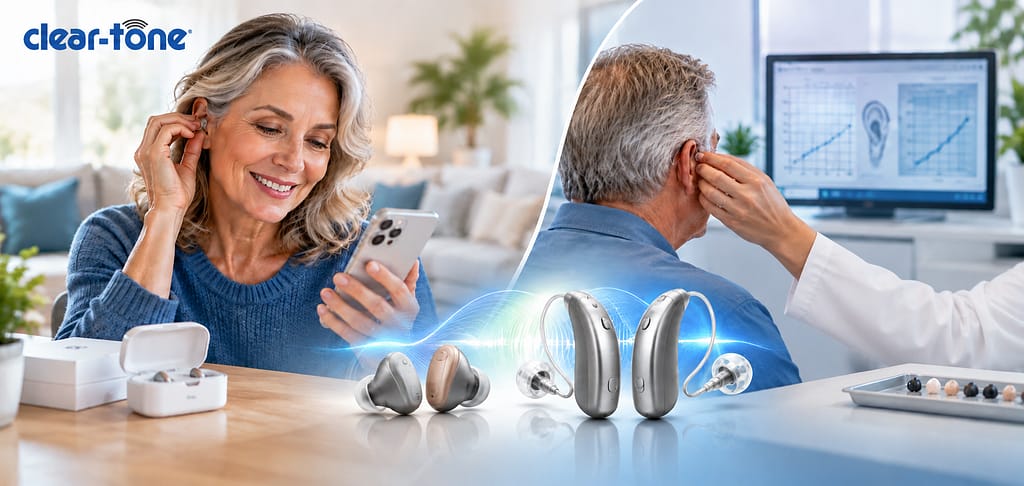
Over-the-counter (OTC) hearing aids are sold directly to adults 18 and older with perceived mild to moderate hearing loss, without a hearing test or professional fitting. Prescription hearing aids are fitted by a hearing aid specialist after a hearing evaluation, and are programmed to your specific hearing loss at each frequency.
Both are real hearing aids and both are regulated by the FDA. The question is not which one is better in the abstract. It is which one matches your hearing, your ears, and how much help you want setting it up.
OTC vs Prescription Hearing Aids: Side by Side
| OTC Hearing Aids | Prescription Hearing Aids | |
| Who they are for | Adults 18+ with perceived mild to moderate loss | Any degree of loss, mild through profound |
| Hearing test required | No | Yes, a full hearing evaluation |
| Who programs them | You, through an app or on-device controls | A licensed professional, to your audiogram |
| Fitting | Self-fitted with standard domes or tips | Professionally fitted, custom earmolds available |
| Technology | Varies widely; often fewer automatic features | Full range, including automatic environment switching and directional microphones |
| Follow-up care | Manufacturer support, usually phone or online | In-person adjustments, cleanings, repairs, rechecks |
| Return window | Varies by retailer, often limited | Trial period, varies by provider |
| FDA regulated | Yes, as its own category since October 2022 | Yes |
| Where to buy | Pharmacies, electronics stores, online | Hearing aid centers and hearing care practices |
(For a breakdown of what hearing aids cost in the Tulsa area, see our separate guide to hearing aid cost in Tulsa.)
What Are OTC Hearing Aids?
In August 2022 the FDA created a new device category, and the rule took effect on October 17, 2022. It allows adults 18 and older with perceived mild to moderate hearing loss to buy hearing aids directly, with no medical exam, no prescription, and no visit to a hearing professional.
You will find them at pharmacies, big-box and electronics retailers, and online. Jabra Enhance, Sony, Lexie, and Eargo are among the better-known names, though some brands sell both OTC and prescription lines, so the label on the box matters more than the brand on it.
What they do well: they remove every barrier between noticing a problem and doing something about it. No appointment, no waiting, no paperwork. For someone with genuinely mild loss who wants to try amplification, that accessibility is a real benefit, and the FDA created the category precisely because too many people were doing nothing at all.
Where they fall short: the word perceived is doing a lot of work in that FDA language. You are diagnosing yourself. Most people are reasonably good at noticing that their hearing has changed and quite poor at judging how much, which ear, or why. A device tuned by guesswork can amplify the wrong frequencies, often making speech louder without making it clearer, which is the most common complaint we hear from people who tried OTC first.
What Are Prescription Hearing Aids?
Prescription hearing aids start with a full hearing evaluation. That test produces an audiogram showing exactly how much hearing you have lost at each frequency, in each ear, and whether the loss sits in the outer, middle, or inner ear.
Your hearing aid specialist then programs the devices to that specific profile: boosting the frequencies you have lost, leaving alone the ones you have not, and verifying the result in the office. Starkey, Signia, and the other major manufacturers all make prescription lines.
The devices come with the services attached: the fitting itself, adjustments over the following weeks as your brain adapts, cleanings, repairs, and periodic rechecks as your hearing changes.
The tradeoff is honest: it takes appointments. You cannot pick them up off a store shelf, though at Clear-Tone, fitting can often happen the same day.
Who Should Consider OTC Hearing Aids?
OTC is a reasonable starting point if all of these are true:
- You notice mild difficulty in some situations (a noisy restaurant, a soft-spoken colleague) but follow most conversations without strain
- You have had a hearing test reasonably recently, and it showed mild to moderate loss
- You are comfortable with an app, and willing to spend time adjusting settings yourself
- Your hearing changed gradually and about equally in both ears
- You have none of the warning signs in the next section
That fourth point matters more than people expect. Symmetrical, gradual loss in both ears is the pattern OTC devices are designed around. Anything else deserves a look first.
Who Should See a Professional First?
The FDA publishes a list of signs that mean you should consult a doctor rather than buying an OTC hearing aid. If any of these apply to you, get evaluated before you buy anything:
- Ear pain or discomfort
- Blood, pus, or fluid draining from the ear within the past six months
- Sudden change in hearing within the past six months
- Hearing that fluctuates, getting better and worse
- Hearing noticeably worse in one ear than the other
- Ringing or buzzing in only one ear
- Severe dizziness or vertigo
- Excessive earwax, or something lodged in the ear
- An ear injury, deformation, or unusual ear shape
The thread connecting these is that each one can signal something an amplifier will not fix and may hide. Sudden hearing loss, for instance, is treated as urgent by ENT physicians, and the window for effective treatment is measured in days to weeks. One-sided loss and one-sided ringing can point to conditions that need imaging rather than amplification.
Beyond the FDA’s list, professional fitting is the better path if your hearing loss is moderate or greater, if you have never had a hearing evaluation, if you tried OTC and it did not help, or if you want devices that adjust themselves as you move between a quiet kitchen and a loud restaurant.
What Professional Fitting Adds
The devices themselves have converged more than they used to. What still separates the two paths is everything around the device.
Programming to a real audiogram. Hearing loss is rarely flat. A typical age-related pattern leaves low frequencies close to normal while high frequencies fall away, and high frequencies are where consonants live. Prescription fitting targets that shape specifically. Self-fitting apps approximate it from a self-administered tone test, which is a reasonable estimate, not a measurement.
Verification in the office. Your provider can confirm what the device is actually delivering into your ear canal, rather than trusting the setting on the screen. Ear canals differ enough in size and shape that the same setting produces meaningfully different results in different people.
Adjustments over time. Almost nobody is fitted perfectly on day one. Your brain has been compensating for reduced input, sometimes for years, and suddenly restoring those frequencies is disorienting. Getting from “this sounds strange” to “this sounds right” usually takes a few visits, and it is where most of the benefit is won or lost.
Fit and comfort. A device that irritates your ear gets left in a drawer. Wear time is one of the strongest predictors of whether hearing aids help, and comfort drives wear time more than any specification does.
Someone to call. When a device stops working, you can bring it in rather than mail it away.
Catching what a hearing aid cannot fix. A hearing evaluation checks for wax impaction and the medical red flags above, and if the ear exam points to a middle ear problem such as fluid, further testing is available. Some of what looks like permanent hearing loss is treatable.
Can You Start with OTC and Switch Later?
Yes, and plenty of people do.
Buying an OTC device does not close any doors. If it helps, that is a good outcome. If it helps less than you hoped, a hearing evaluation will show you why: whether your loss is steeper than the device is built for, shaped differently than the app assumed, or not the kind of loss amplification addresses at all.
The one thing worth avoiding is spending a year quietly disappointed with a device that was never going to be enough, and concluding that hearing aids do not work for you. They may simply have been the wrong ones.
Get a Baseline First
Whichever route you take, knowing your actual audiogram makes the decision better. If you are leaning toward OTC, a hearing test tells you whether your loss is in range and rules out the medical red flags. If you are leaning toward prescription, the test is the first step anyway.
Hearing tests at Clear-Tone Hearing Aids are free, and there is no obligation attached. If your results show mild loss and an OTC device would suit you, we will tell you so. Book a free hearing test, call (918) 493-4000, or stop by 2323 S. Sheridan Rd. in Tulsa, Monday through Friday, 8:30 am to 5 pm.
If you already know you want professional fitting, our guides to hearing aids and hearing aid styles cover the options, and the comprehensive hearing test and evaluation page explains what the full workup involves.
Frequently Asked Questions
Should I get OTC or prescription hearing aids?
OTC is a reasonable option if you are an adult with mild to moderate loss in both ears, no medical warning signs, and you are comfortable self-fitting. Choose prescription if your loss is moderate or greater, affects one ear more than the other, came on suddenly, or comes with pain, drainage, dizziness, or one-sided ringing. A hearing test settles the question quickly.
Are OTC hearing aids as good as prescription hearing aids?
For mild loss, a well-chosen OTC device can work well. The gap widens as loss increases, because prescription devices are programmed to your measured hearing at each frequency and verified in the office, rather than estimated from a self-administered test. The professional services attached (fitting, adjustments, repairs) are a large part of the difference.
Can I buy OTC hearing aids at Walmart or Walgreens in Tulsa?
Yes. Since the FDA rule took effect in October 2022, OTC hearing aids have been sold at pharmacies, big-box retailers, electronics stores, and online, with no prescription or hearing test required.
Do hearing professionals recommend OTC hearing aids?
Many hearing professionals do recommend them, for the right patient. OTC devices lower the barrier for people with mild loss who would otherwise do nothing for years, and doing something is generally better than waiting. What most professionals caution against is not the devices themselves but the skipped evaluation, since self-diagnosis can miss a treatable medical cause or an ear that needs attention rather than amplification.
What is the 5-minute rule for hearing aids?
It applies to disposable zinc-air batteries, used in some OTC and some prescription devices. After peeling the tab off a new battery, wait about five minutes before inserting it. Zinc-air batteries activate through contact with air, and letting them fully activate first can extend how long the battery lasts. It does not apply to rechargeable hearing aids.
What is the OTC Hearing Aid Act?
It is the 2017 federal law that directed the FDA to create a category of hearing aids sold without a prescription. The FDA issued the rule in August 2022 and it took effect on October 17, 2022, establishing OTC hearing aids for adults 18 and older with perceived mild to moderate hearing loss.
How do I know if my hearing loss is mild or moderate?
You cannot know reliably without a hearing test, because the categories are defined by measured thresholds in decibels, not by how hearing loss feels. As a rough guide, mild loss means missing soft speech and struggling in background noise, while moderate loss means regularly missing speech at normal conversational volume. A free hearing test gives you the actual number.
Can I return OTC hearing aids if they do not work for me?
Usually, but return windows vary by retailer and are often shorter than the trial periods offered with prescription devices. Check the specific return policy before you buy, and note the deadline, since hearing aids typically need a few weeks of consistent wear before you can judge them fairly.